



We help businesses across Brisbane and SE Queensland achieve their goals sooner with smarter, more reliable technology.




A business continuity plan is most likely to fail not because it lacks detail, but because it remains untested and unfamiliar until a real crisis. The true risk is discovering its flaws only when your business is already under pressure.
A business continuity plan usually breaks down at one predictable point: it gets written, saved, and forgotten, so when something actually goes wrong, nobody remembers where it lives or how to use it.
That's the real design flaw. A business continuity plan is supposed to carry your team through a disruption, but most are never rehearsed, so you genuinely don't know whether yours works until the day it's tested for real.
A plan only earns its keep when it's practised, not just written. Left untouched, it does the opposite of what it promises - it gives you confidence you haven't actually earned.

Most businesses treat a written plan as the finish line, but a plan nobody has rehearsed is a bit like a fire extinguisher nobody's ever pulled the pin on. The instructions might be fine; the problem is nobody's muscle memory matches them.
So when the pressure's on, teams go looking for the document first and figure out the actual response second - which is exactly backwards.
That gap isn't really about what's missing from the plan's content. It's about familiarity. Even a thorough, well-written plan turns foggy the moment people are reading it under stress instead of having walked through it before.
For Brisbane businesses, where storms, outages and cyber incidents are a genuine ongoing risk rather than a hypothetical, that gap between the document and the drill is what decides whether you're back up quickly or stuck explaining a long outage to customers.
Continuity planning isn't finished once the steps are written down - it's only proven once your team can actually run them. If staff haven't walked the process at least once, they're guessing at their role the first time it matters, and guessing is exactly what a plan is supposed to prevent.
A plan also ages the moment it's filed away. Staff moves on, systems change, vendors change, and a document that was accurate on the day it was signed off can be quietly wrong a year later. Regular practice is what catches that drift before a real event does.
So the value in continuity planning isn't the file - it's the habit. That means drills, current contact lists, and everyone knowing exactly where the plan sits and how to open it in a hurry.
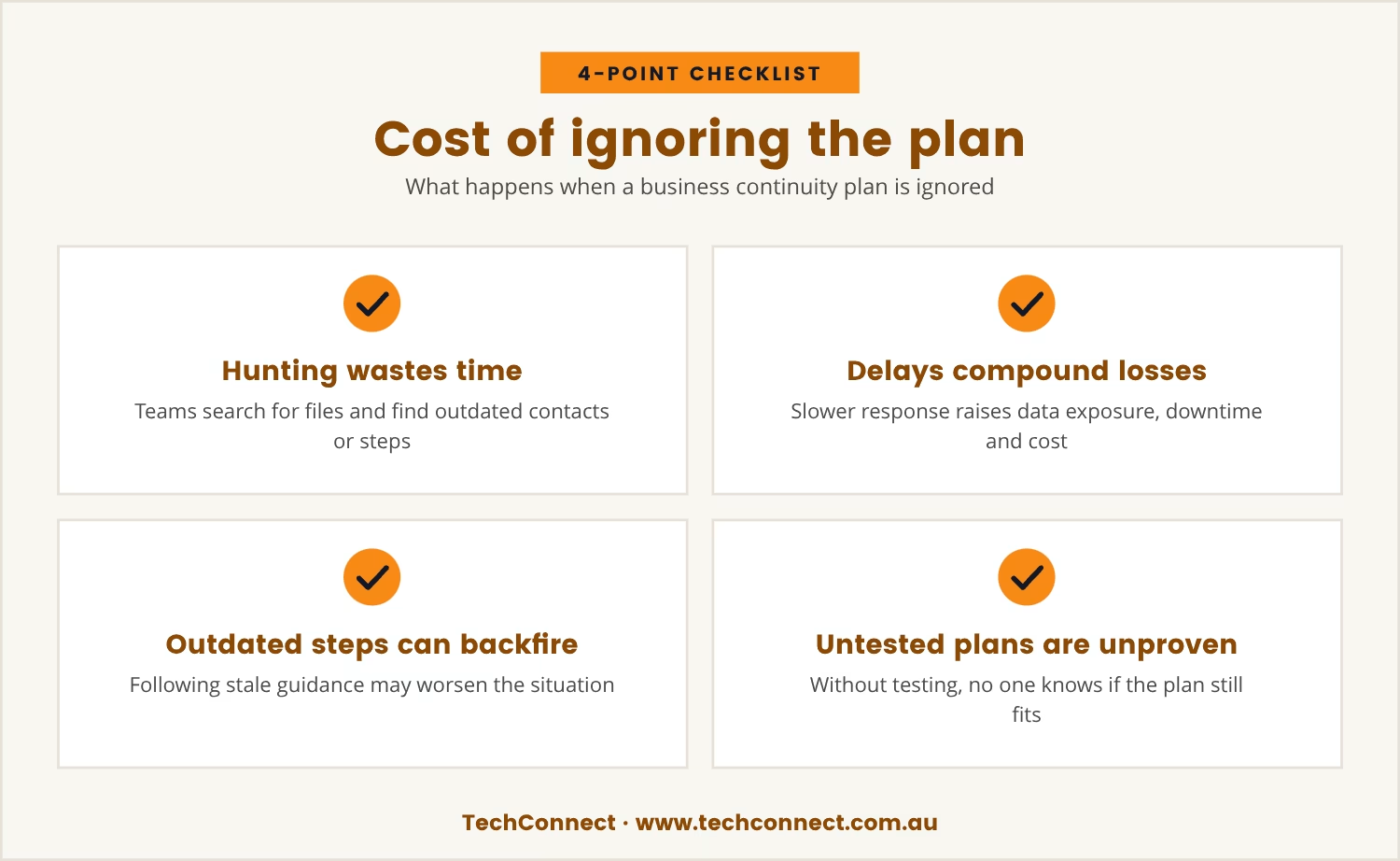
A business continuity plan that only gets opened once disaster has already started tends to create a second problem on top of the first. Instead of acting, people spend the first critical stretch hunting for the right file, then discovering a contact's gone or a step doesn't match how the business actually runs now.
That delay compounds. The longer it takes to get moving, the more data exposure, downtime and cost stack up - and customers and reputation absorb a good share of that too.
In a pattern we'd expect to show up again and again rather than something tied to any one business, following an outdated step can genuinely make things worse than doing nothing. Without testing, there's no honest way to know if the plan still matches the business it's meant to protect.
An effective BCP is one your team already knows and trusts, not one they're reading for the first time mid-crisis. Here's roughly what separates a working plan from a shelved one.
Everyone should know, ahead of time, exactly what's expected of them the moment something breaks. That clarity has to exist before the disruption, not get worked out during it.
Practise the plan about once a year, give or take, and vary the scenario - an IT outage one time, a natural disaster the next - so the response gets tested, not just the document.
Staff, vendors, and technology all shift over time, so the plan needs the same regular review. Stale contact details are one of the simplest ways a response stalls.
Every drill and every real incident teaches you something, so use it. Fold what worked, and what didn't, straight back into the plan.
The plan has to be findable even when your main systems are the thing that's down. Printed copies or an offline backup cover that gap.
People protect what they understand the value of, so remind them regularly why the plan matters and what their part in it is. A plan nobody feels ownership over won't get followed.
Even a plan that looks solid on paper can carry warning signs that it won't hold up in a real event. Worth checking for:
When a plan fails at the exact moment it's needed, the fallout tends to be more than inconvenient. Extended downtime drains revenue, frustrates customers, and - where sensitive data's involved - can bring regulatory exposure into the picture too.
Money is only one part of the cost, though. The stress and confusion of nobody quite knowing what to do next wears down team morale and trust, and that alone can stretch out how long full recovery actually takes.
So testing isn't a box-ticking exercise - it's closer to an investment in how fast you bounce back. It surfaces the gaps while they're still cheap to fix, instead of while the business is already offline.
A business continuity plan earns its value only by staying a living process - something the team actually practises and revises - rather than a file that sits untouched on a drive.
We'd argue the first stretch of any continuity engagement has to be spent calming the environment down and tightening up security posture, because that's simply the order urgent gaps and strategic improvement have to come in - you can't meaningfully prioritise improvement projects on top of a foundation that's still shaky.
Only once that base is steady does it make sense to sit down and reorder priorities toward the projects that actually move the business forward. Roughly three months is what that stabilising stretch tends to take, give or take, before that reprioritisation conversation is worth having.
Ask yourself: when did your team last run the plan start to finish? If you're not sure, that's the signal to book a drill and update whatever the drill exposes.
Treat the plan as an ongoing process rather than a one-off document, and you build resilience that's actually real - a team that can act, not just a team that can read instructions, when something unexpected lands.

Many businesses with 15 to 70 users have a business continuity plan that looks good on paper but hasn’t been tested in a real crisis. At TechConnect, we understand how easy it is for a plan to get forgotten until it’s too late.
If you want to see how we help businesses make their continuity plans practical and reliable, let’s talk about your setup and what would actually work for your team.
If you find a lower price for the same level of service, we’ll match it—no negotiation required. Make your business continuity process stronger without paying more.
[.mspl-button-text]Request a price match[.mspl-button-text]
About once a year is the rough benchmark, plus whenever there's a major shift in your team, technology or processes. Testing on that rhythm is what keeps everyone clear on their role and keeps the plan matching how the business actually runs.
Continuity planning is about keeping the business functioning through any kind of disruption, covering people, processes and facilities. Disaster recovery is narrower - it's specifically about restoring IT systems and data after a major incident.
A BCP should be built with input from across the business - IT, operations, HR and management at minimum. Bringing those perspectives together is what makes sure every critical function is covered and everyone understands what's expected of them.
Keep copies in more than one place - a secure cloud service, a printed copy, an offline backup - so a single system going down doesn't take the plan with it. Every team member should know exactly where those copies sit.
A plan left unreviewed tends to accumulate outdated procedures, wrong contact details, and blind spots around newer risks. That combination is what turns a real incident into longer downtime and a bigger financial hit than it needed to be.
We help businesses across Brisbane and SE Queensland achieve their goals sooner with smarter, more reliable technology.