

We help businesses across Brisbane and SE Queensland achieve their goals sooner with smarter, more reliable technology.




An ISMS with a weak or narrow scope can pass ISO 27001 certification but will make every management review more complex and time-consuming. This ongoing workload adds administrative costs without truly reducing information security risk.
ISO 27001 scope decisions don't stop mattering once a certificate is issued — the boundary you draw at the start keeps shaping how much work shows up at every management review afterwards. Draw it too narrow or too vague and the system can still pass its first audit; the strain tends to surface later.
A thin scope quietly becomes a habit: each review ends up re-justifying what's left out, pulling attention away from the risk you're actually meant to be managing.
Passing an ISO 27001 audit with a weak scope can leave you with more paperwork and less protection than you expected.
ISO 27001 is the internationally recognised framework for identifying, assessing and controlling information security risk. It's only as good as the care put into scoping it on day one.

The scope of your ISMS marks out which parts of the business the standard covers, and that call gets made once, early, then lives with you for years.
Set it too narrow and only a slice of the organisation sits inside the fence — manageable at first glance, until every management review turns into a debate about what's fenced in and what isn't.
An unclear scope compounds the problem: controls get bolted together without quite matching up, so reviews spend their time clarifying boundaries instead of managing risk.
Get the scope right, though, and reviews become what they're meant to be — a check on progress, not a re-argument of the basics. The effort you put in at the start pays out every year after.
Management reviews exist to show leadership whether the ISMS actually works and where it needs attention, but a weak scope turns that exercise into a yearly defence instead.
Each cycle, managers end up re-explaining the same boundary, which means extra documentation, more auditor questions, and time spent settling arguments that should've been closed at the start.
None of that lowers information security risk — it just keeps the team busy defending a decision instead of building on it.
For businesses in Brisbane, that usually shows up as more hours on paperwork and fewer on the controls that actually matter, which is the opposite of what the certificate is supposed to deliver.
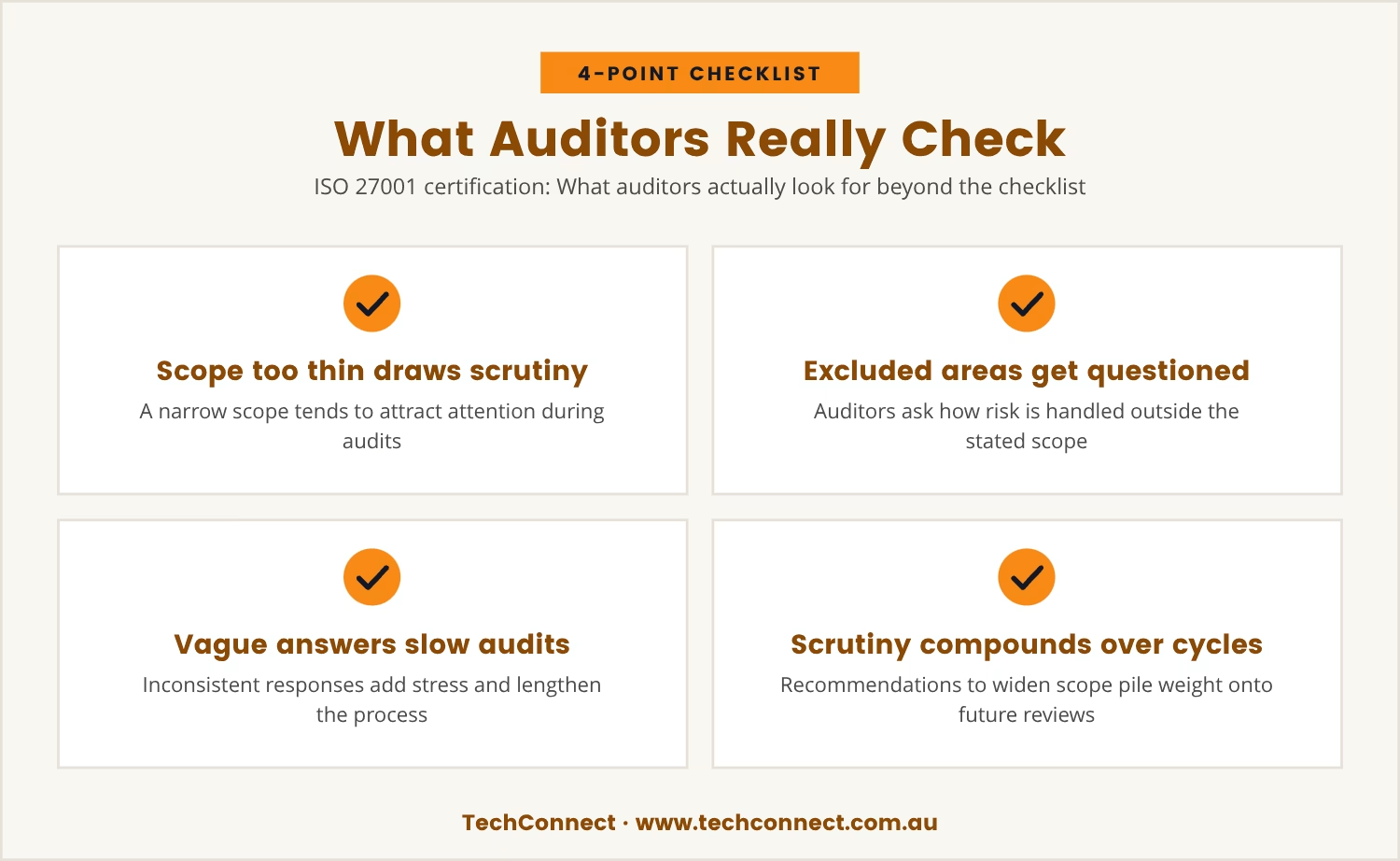
Auditors aren't just ticking boxes against ISO 27001 — they're checking the ISMS works in practice, and a scope that's too thin tends to draw attention during surveillance audits and recertification.
They'll ask why a department or process sits outside the fence, and they'll want to see how risk gets handled there anyway, even though it's technically out of scope.
Vague or inconsistent answers stretch the audit out and add stress to a process that should be routine.
Over a few cycles, that scrutiny tends to produce recommendations to widen the scope or tighten controls, and each one adds weight to what the next management review has to carry. The certificate stays on the wall; the effort to keep it climbs.
A weak ISMS scope rarely shows up as one big problem — it shows up as pressure building in five places, review after review.
Every review, someone has to justify again why part of the business sits outside the ISMS, and that justification rarely gets simpler with repetition. It just adds another round of documentation to redo.
New departments or services tend to land outside the original scope by default, so the review has to decide whether the ISMS should stretch to cover them. That decision adds work each time it comes up.
Auditors often flag a narrow scope as a risk in itself, so the review ends up responding to the flag instead of improving security. The conversation shifts from risk to damage control.
Covering only part of the organisation can leave controls overlapping or pulling against each other, and reviews have to untangle it. That work eats time that should go toward reducing risk.
Risk doesn't stop at the edge of the ISMS scope, so reviews have to weigh whether what's happening outside it could still reach in. That alone makes the assessment more complex than it needs to be.
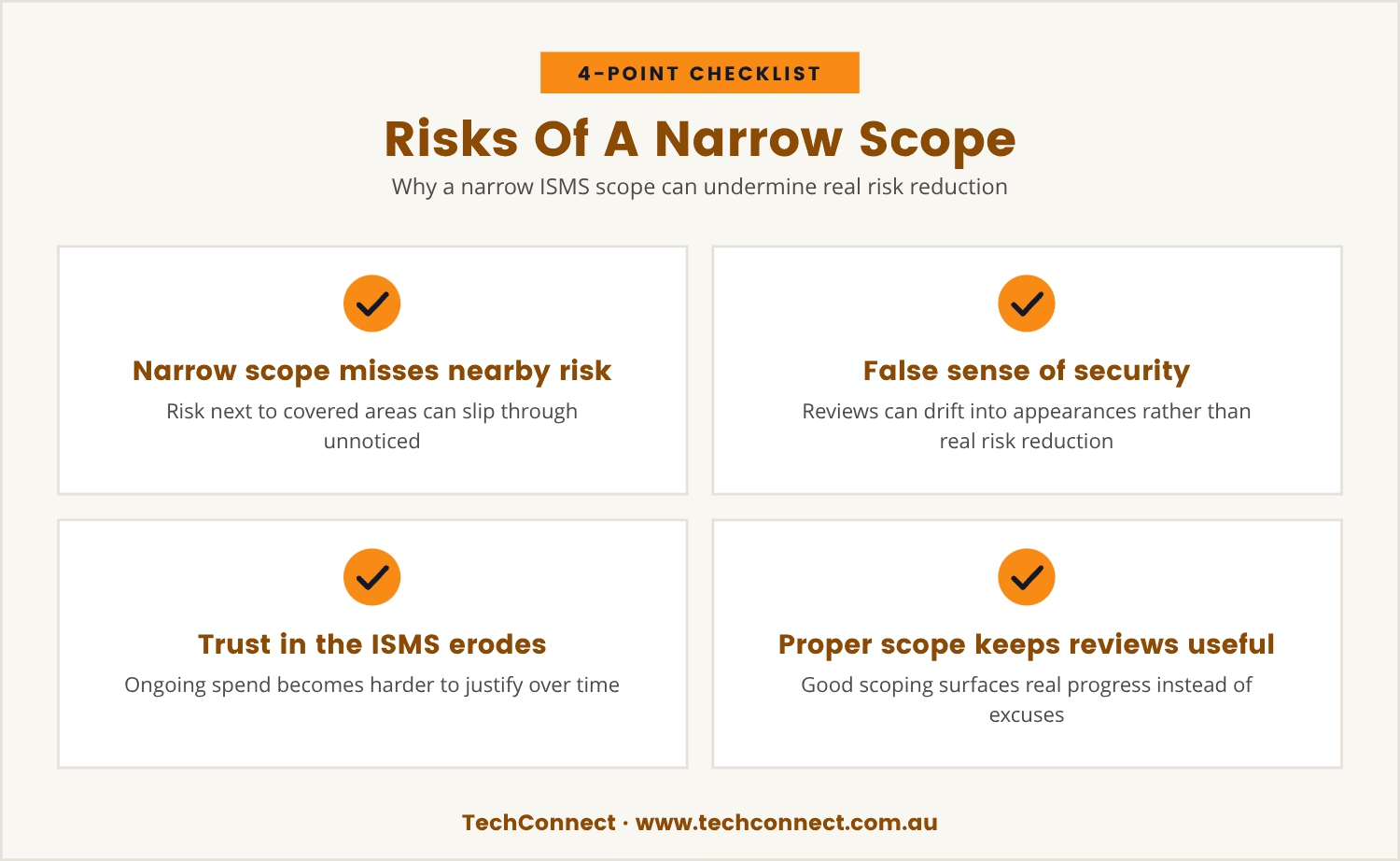
ISO 27001 is meant to help manage information security risk, not just produce a certificate, and a scope drawn too narrowly can miss risk sitting right next to the parts you did cover.
That gap creates a false sense of security, and the management review slips into maintaining appearances rather than actually reducing exposure.
Left long enough, that erodes trust in the ISMS itself and makes the ongoing spend harder to justify.
A properly scoped system avoids the trap — reviews stay useful, surfacing new risk and real progress instead of excuses.
A handful of practical habits keep management reviews focused on real improvement instead of scope arguments.
Our instinct is that the first few months after certification should go purely toward calming the environment down — lifting a shaky security posture, closing the obvious gaps, getting the basics boringly solid, roughly three months, give or take.
Only once that's settled does it make sense to sit down and reorder what comes next, pointing effort toward genuine improvement and automation projects instead of more documentation chasing.
We're not fully certain three months is the right window for every organisation, but the sequence — stabilise first, reprioritise second — seems to hold regardless of how the ISMS is scoped.
The administrative cost of keeping an ISO 27001 certificate can run higher than expected when the ISMS scope wasn't set up with care, because every management review turns into a round of defending past decisions instead of moving forward.
We see this pattern most often somewhere around 15 to 70 users, though we wouldn't call that a hard boundary — it's just where the extra time and money spent on compliance activity tends to become noticeable, without doing anything for actual security. The certificate hangs on the wall; the value behind it shrinks.
A thoughtful scope at the outset heads this off, saving years of extra work and keeping each management review productive — so the return on your ISO 27001 investment actually shows up.

If your business has 15 to 70 users, you may be facing the challenge of keeping your ISO 27001 certificate without letting admin work spiral out of control. At TechConnect, we understand how easily a poorly scoped ISMS can lead to more paperwork and less real security.
We invite you to see how our approach focuses on getting the scope right from the start, so your management reviews stay productive and your compliance effort delivers real value.
If you find a lower price for the same level of service elsewhere, we’ll match it automatically—no negotiation required.
[.mspl-button-text]Request your price match[.mspl-button-text]
Revisit it at least once a year, or sooner if the business changes — new services, new locations, new technology. That keeps the ISMS lined up with the risks you actually carry, rather than the ones you had when you first certified.
An internal audit checks whether the ISMS matches the ISO 27001 standard and follows your own documented processes. A management review is where leadership weighs overall performance, looks at audit results, and decides what to change — both are required, and they do different jobs.
A narrow scope can lower the upfront certification cost, since fewer areas get audited, but it tends to raise the ongoing bill. Every management review and surveillance audit then needs extra work to justify what's excluded, and that adds up over time.
Annex A controls are the set of recommended security measures inside ISO 27001. Not every one applies to every organisation, but any you leave out need a clear justification from your risk assessment, and that justification gets checked at audit.
The Essential Eight is a set of cybersecurity strategies recommended for Australian businesses, separate from ISO 27001 itself. The two can work together, though — Essential Eight tackles specific technical risks in a way that helps satisfy some of the standard's broader requirements.
We help businesses across Brisbane and SE Queensland achieve their goals sooner with smarter, more reliable technology.