



We help businesses across Brisbane and SE Queensland achieve their goals sooner with smarter, more reliable technology.



Reporting alone does not deliver real control over cloud costs. Only by shifting ownership, visibility, workload attribution, and automation does cost management become actionable and effective.
Cloud spend rarely stops quietly. It leaks through idle servers, forgotten storage and resources nobody remembers switching on, and that leak keeps draining the budget long after the invoice lands on someone's desk.
Most businesses treat a monthly report as the finish line, but reporting isn't the same as reducing what you spend. The gap shows up starkly in the numbers: only 30% of companies can trace even half of their cloud bill to the workloads that created it.
Cloud cost optimization means shaping those numbers, not just narrating them back from a dashboard. Skip the shaping part and a business ends up watching its bill climb with a very detailed explanation of why.
Four shifts separate businesses that merely watch their cloud spend from businesses that actually steer it, and the sections below walk through each one in turn.

Plenty of businesses in Brisbane start the cloud cost conversation with a spreadsheet of monthly totals, and that habit feels responsible even when it isn't doing much work. Tracking tells you where the money went - it doesn't tell you why the number keeps climbing or what stops it next month.
A dashboard that flags a spike doesn't fix the spike, it just names it. Naming the same problem every month without the authority to act on it turns reporting into a ritual rather than a remedy.
Monthly statements and built-in provider tools are genuinely useful for spotting a trend line, but they can also create a false sense of control, as if seeing the number were the same as owning it.
Getting from passive observation to active management comes down to changing who owns the outcome, how visibility works, whether spend connects to a workload, and how much of the fix runs without a human pressing a button - which is exactly what the next section covers.
Four changes separate a business that watches its cloud bill from one that actually steers it, and each shift closes a gap that reporting alone leaves wide open.
Our instinct, held loosely, is that the opening stretch of any engagement - somewhere around three months - isn't about optimization at all. It's about calming an environment that's usually landed in a mess for fairly ordinary structural reasons: nobody owns the score, tooling sprawled faster than anyone tagged it, and the security posture needs rebuilding before anything else is worth touching.
Once that's settled, roughly around month three, we sit down with the client and reorder the whole priority list toward improvement and automation projects - because running cost governance on top of an unstable environment is a bit like fixing the engine while the car's still rolling.
Cost control starts the moment someone owns the number, not just reports it. Hand that job to a FinOps lead or a single accountable manager, and cloud spend stops being everyone's problem and nobody's priority.
A total on a dashboard tells you what you spent, not what drove it. Real visibility breaks that number down by service, team and project, so waste and idle resources surface before they compound.
Attribution ties each dollar to the workload or business function that generated it. Know that, and decisions about scaling, rightsizing or shutting something down stop being guesswork.
Manual changes can't keep pace with cloud usage that shifts hour to hour. Governed automation sets rules - shutting down idle resources, capping budgets - that apply the same way every time, turning cost management from reactive into proactive.
Once those four shifts are in place, a handful of concrete tactics start actually paying off:
None of these do much on their own. They lean on the four shifts underneath them, and skip those and even the sharpest tactic falls flat.
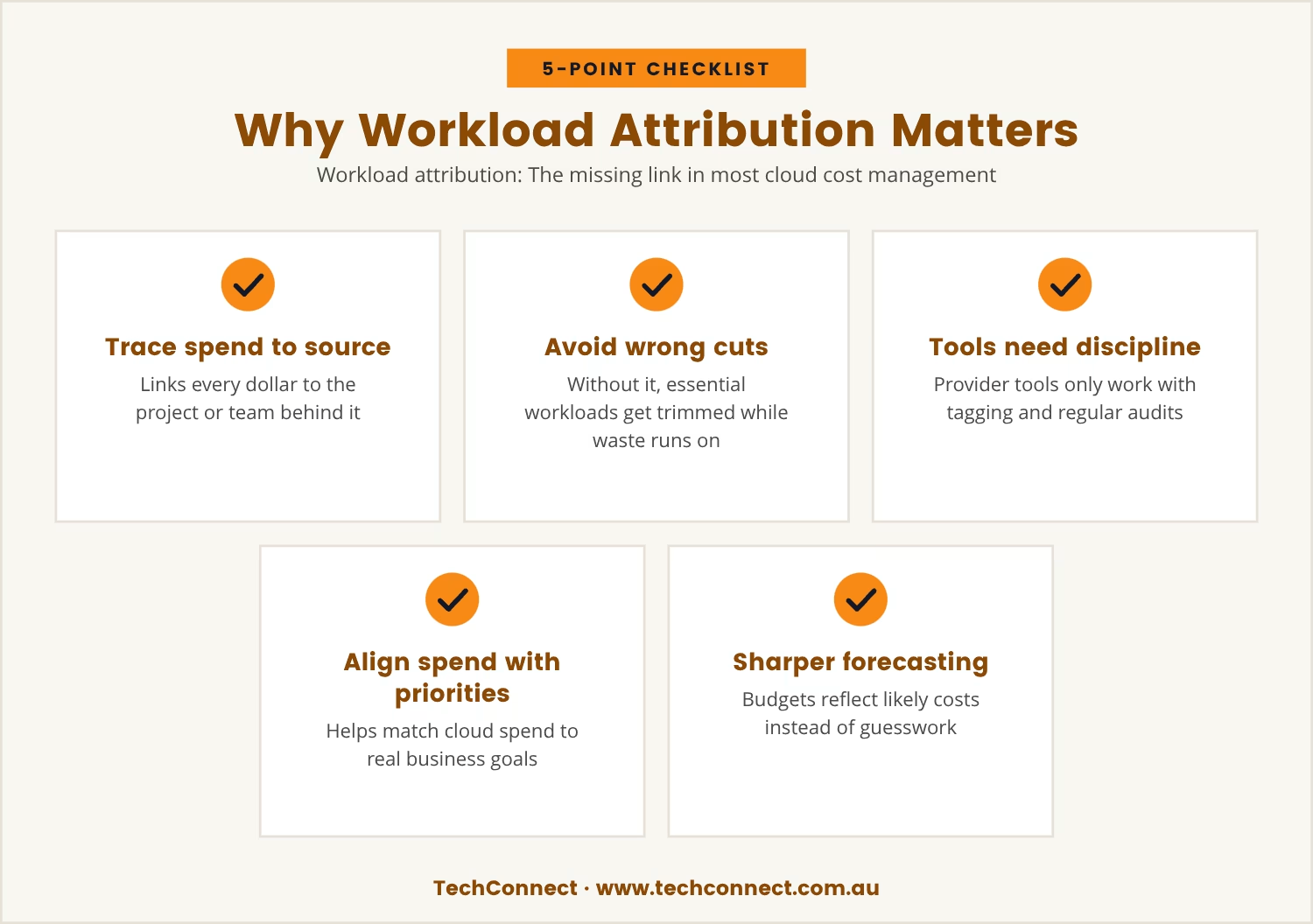
Workload attribution rarely gets the attention it deserves, yet skipping it is what keeps most cost efforts stuck at reporting. Attribution means tracing every dollar back to the project, team or goal that spent it; without that trace you're left staring at totals with no sense of cause.
Miss attribution and the cuts land in the wrong place - essential workloads get trimmed while the genuinely wasteful ones keep running unnoticed, which is exactly the mismatch that breeds frustration when savings never show up.
Cloud providers ship tools that help with attribution, but none of them do the job without consistent tagging and a regular audit behind them. For businesses in Brisbane weighing up where to start, that discipline is a practical way to line cloud spend up against actual business priorities.
Attribution also sharpens forecasting - once you know which workload drives which cost, budgets stop being a guess and start reflecting what's likely to happen next quarter.
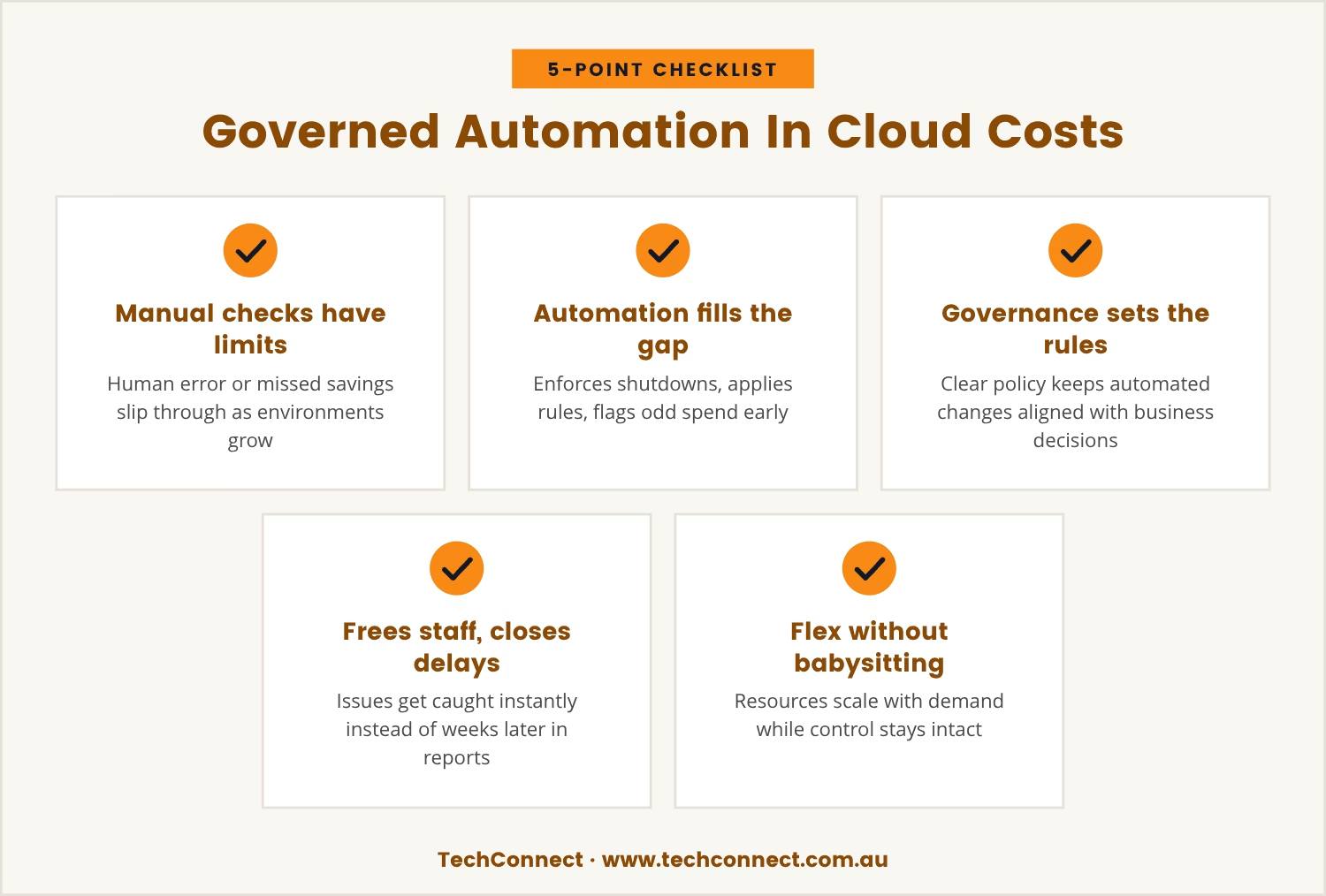
Manual intervention only stretches so far once a cloud environment grows past a certain size, and every extra hour of manual checking is another hour where human error or a missed saving slips through.
Automation picks up the slack - enforcing shutdown schedules, applying cost-saving rules, flagging spend that looks off before it becomes a line item nobody can explain. The part that actually matters is governance: clear policy that the automation follows, so every change lines up with what the business already decided mattered.
That frees staff up for work that actually needs a human, and it closes the gap between an automated rule catching an issue and someone noticing the same thing three weeks later in a report.
Pair automation with real governance and a business can flex resources up or down as demand shifts, holding control without anyone babysitting the dashboard.
Ownership, visibility, workload attribution and governed automation each close a different gap, and skipping any single one leaves that gap for reporting to paper over instead of fixing.
No owner, and nobody drives the action. No visibility, and the problem stays hidden. No attribution, and every decision is a guess dressed up as a plan. No automation, and the fix arrives too late to matter.
Drop even one of the four and cost management slides back into reporting - you can see exactly what you spent, but changing it stays out of reach. Real control means running all four together, not picking a favourite.

Many businesses with 15 to 70 users find themselves tracking cloud costs but struggling to make real changes. At TechConnect, we understand how easy it is to get stuck in reporting mode instead of gaining true control.
We invite you to see how our approach can help you move beyond monitoring and take practical steps to manage your cloud spend more effectively.
If you find a lower price for the same level of service elsewhere, we’ll match it—no negotiation required.
[.mspl-button-text]Request a price match[.mspl-button-text]
Start by giving one person clear ownership of the cloud bill, even without a formal FinOps team behind them. From there, built-in provider tools can cover basic visibility by service or project, and a simple scheduled shutdown handles a good chunk of the waste without extra spend.
Cloud cost optimisation stretches a growing business's budget further by cutting out waste before it compounds. Controlling spend this way means more room to invest in the things that actually move the business forward, instead of quietly paying for resources nobody's using.
Running multiple cloud providers multiplies the reporting formats you're working from, since each one bills and reports differently. Standardising tags across platforms and leaning on a third-party tool to aggregate the numbers is what keeps visibility intact once more than one provider is in the mix.
Pricing models - pay-as-you-go, reserved instances, spot pricing - describe how a provider charges for compute in general. A savings plan, the kind AWS offers, is a specific discount in exchange for committing to a usage level over time, and which one fits depends on how predictable your usage actually is.
Automation earns its keep with seasonal workloads especially, scaling resources up or down as demand actually shifts. That means paying for what's in use rather than what's provisioned, and it cuts out a fair amount of manual juggling during the peak stretch.
We help businesses across Brisbane and SE Queensland achieve their goals sooner with smarter, more reliable technology.