

We help businesses across Brisbane and SE Queensland achieve their goals sooner with smarter, more reliable technology.



Social engineering works because attackers use workplace routines and courtesy, not just gaps in technical knowledge. Businesses that focus only on technology remain vulnerable if they ignore how people actually work.
Most people assume social engineering is a technology problem, something a firewall or antivirus should catch. In practice it's hardly ever technical - attackers get what they want simply by asking for it, in a way that slots straight into a normal working day.
What makes these attacks land isn't a lack of technical know-how on anyone's part. It's that people trust each other, want to help, and follow the routines a busy workplace runs on - and that combination is something software alone was never built to stop.
So the starting point for real defence is understanding how these attacks actually work, not buying another tool. If you've assumed technology has this covered, it's worth looking at the human and habitual side of the business too.

Plenty of Brisbane businesses run on the goodwill of their teams - holding doors, answering emails quickly, helping a colleague out without asking too many questions. Those habits are exactly what makes a workplace pleasant to be in.
The trouble is, the same habits are a gift to anyone looking to get in uninvited. Attackers study how an organisation actually operates and then simply dress to match it. A well-timed, polite request can walk straight past security controls that would stop almost anything more obvious.
Picture someone calling and claiming to be from IT, asking for a password reset. Because helping each other is just how the place works, staff often comply without a second thought - and that's not a knowledge gap, it's trusting behaviour doing exactly what it's designed to do.
Because the approach relies on politeness and routine rather than technical trickery, it rarely raises an eyebrow. The attacker isn't breaking the pattern of the day - they're fitting into it.
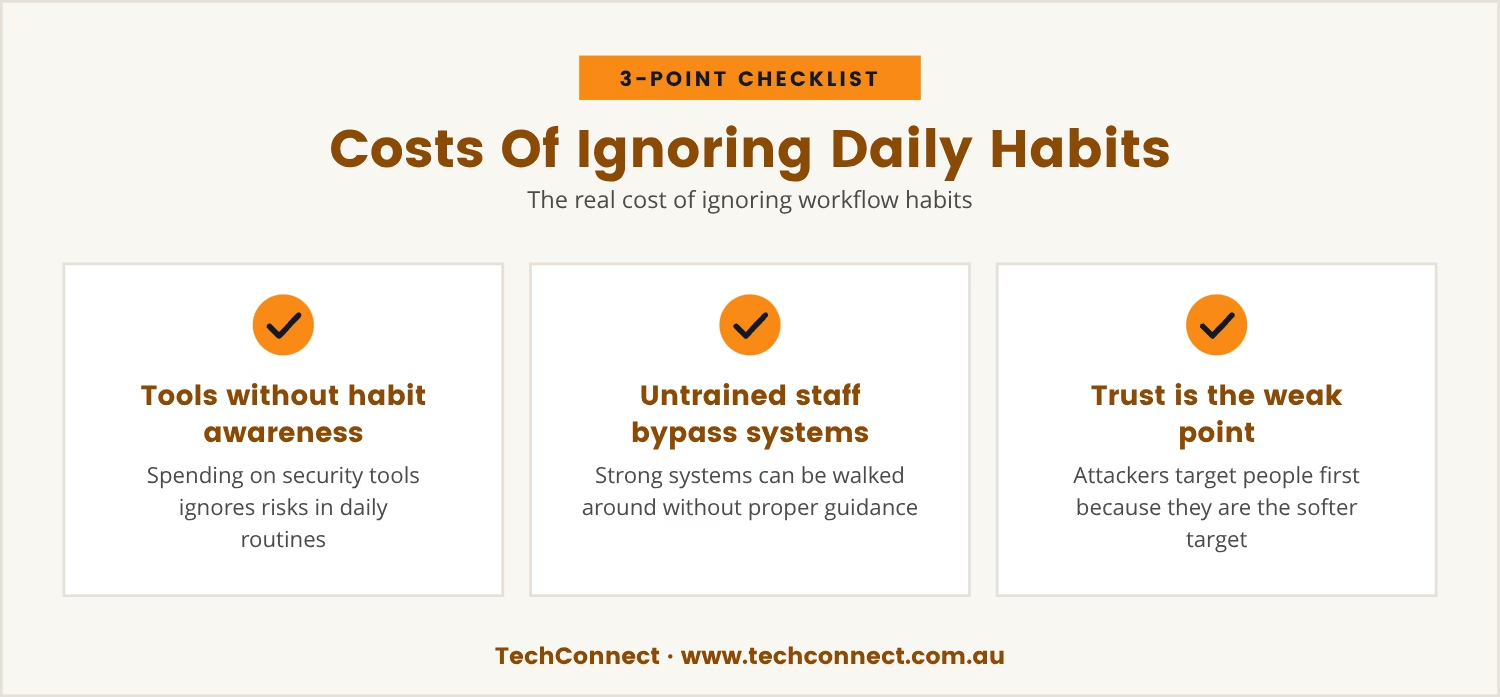
Most businesses spend on security tools without giving much thought to the risk sitting inside their own daily routines. If your team has never been shown what an unusual request looks like, even strong systems can be walked around.
One moment of misplaced trust is often all it takes to open the door to a breach, which is exactly why attackers go after the human side of an organisation first - it's usually the softer target.
Left unaddressed, that gap costs more than money. Reputation takes a hit, client trust erodes, and operations get disrupted - and those are often harder to put right than a compromised system ever was.
That's why technical controls, however good, need to be matched by a genuine understanding of how people work day to day.
A lot of organisations assume the latest security tools are enough on their own. Social engineering is built to get around exactly that assumption, because it targets people rather than systems.
Even strong security can be undone by one well-crafted request - a phishing email made to look like it's from a trusted manager, for instance, is often all it takes to get someone to share information or click a link.
Technical tools can block plenty of threats, but they can't stop someone from being helpful or following an instruction that looks routine. That's the real reason social engineering keeps working - it operates entirely within the bounds of normal workplace behaviour.
Closing that gap means addressing both sides of the problem - looking past the software and paying attention to how your team actually interacts, with each other and with outsiders.
Attackers lean on workplace habits and courtesy in a handful of recurring ways. Here are the most common types of social engineering attack.
Phishing is a fraudulent email or message made to look like it's from someone trustworthy. The aim is simple: get the recipient to hand over sensitive information or click a malicious link.
Spear phishing is the targeted version - the message is built around a specific person or role. That extra customisation makes it more convincing and considerably harder to spot.
Pretexting is an invented scenario or identity used to earn trust. The attacker might pose as a supplier, a coworker, or even a government official to get information or access.
Baiting dangles something tempting - free software, or a USB drive left somewhere obvious - to get someone to take an action that compromises security.
Vishing and smishing use phone calls and text messages instead of email to get people sharing information or clicking a link. Underneath, they rely on the same trust and routine as any phishing attempt.
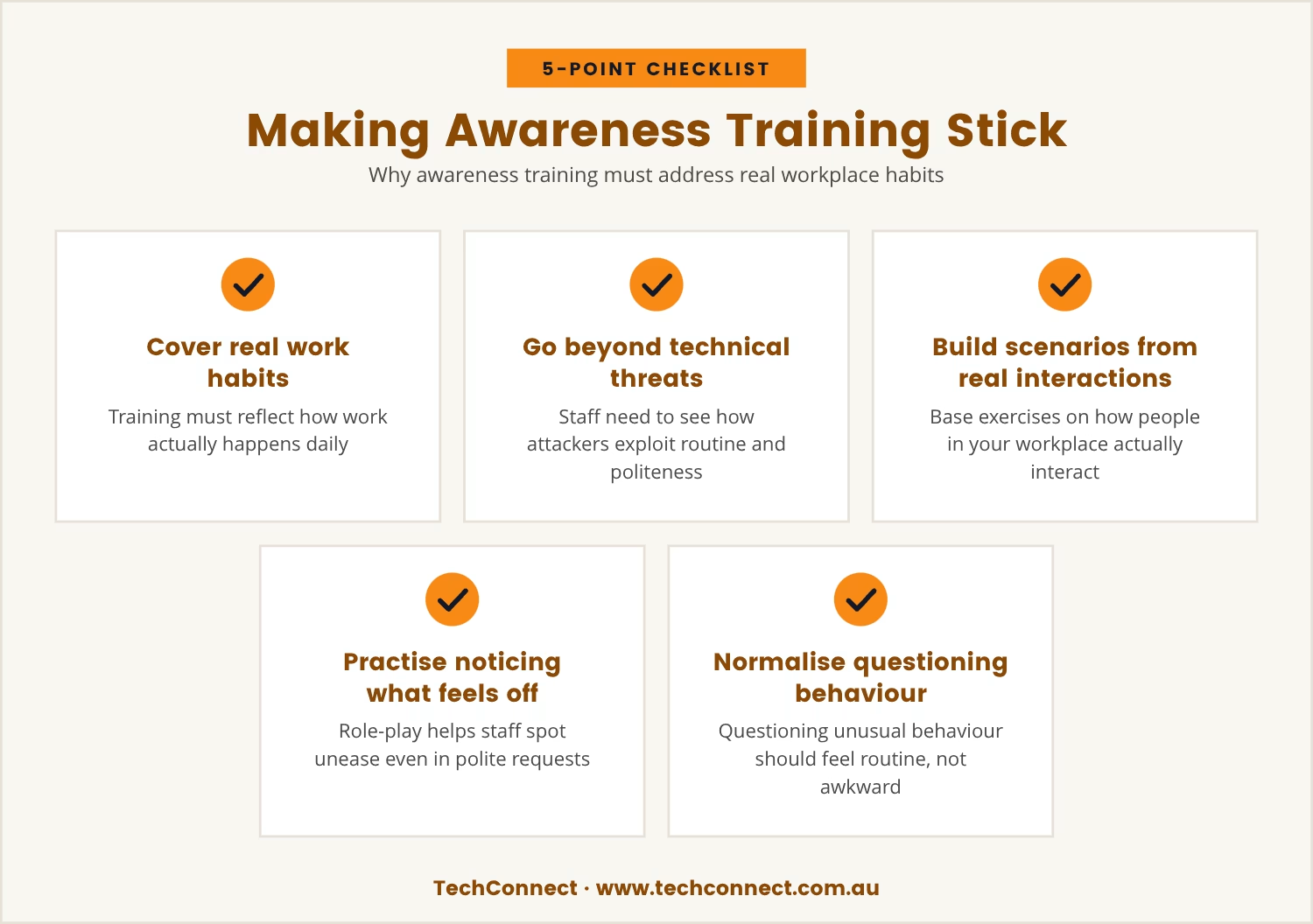
Plenty of organisations run security awareness training, but not all of it deals with how work actually happens day to day. Training that only covers technical threats misses the point - staff need to see how attackers use routine and politeness against them specifically.
A genuinely effective security awareness training program starts by looking at how people in your workplace actually interact, then builds real scenarios around that - how to handle an unexpected request, what to do when someone asks for access to a restricted area.
Role-play and practical exercises help staff notice when something feels off, even if the request sounds perfectly polite. The aim is for questioning unusual behaviour to become normal, not an exception people feel awkward about.
Training built around daily habits, rather than generic threats, is what actually prepares people to spot manipulation and stop it before it works.
Attackers rarely stand out - they lean on small, believable actions to earn trust and access. Here's how that usually looks in practice:
Every one of these sits comfortably inside normal workplace behaviour, which is exactly why they're hard to catch without the right awareness.
Brisbane businesses deal with the same balancing act as anywhere else - staying efficient without leaving the door open. The local culture of trust and helpfulness is a genuine strength, but left unmanaged, it becomes exactly the vulnerability attackers are counting on.
A practical starting point is reviewing your own workflows. Are there moments where staff are expected to help without question? Is there a clear way to verify a request that comes from outside the usual channels?
Small adjustments - staff double-checking anything unusual, or feeling able to challenge a stranger in a secure area - cut the risk of social engineering without costing the business its culture.
The strongest defence against social engineering pairs reliable systems with informed people. Technology matters, but it was never going to replace staff being alert to manipulation.
Lean on technical controls alone, and you leave exactly the gap an attacker is looking for. Real security comes from understanding how your team actually works and making sure everyone knows how to spot and respond to something that doesn't add up.
We think the first few months of any engagement are mostly about calming things down - plenty of workplaces drift into a messy, reactive state over time without anyone quite planning it that way, and getting the security basics tightened up is job one. It takes us about three months, give or take, to get an environment properly stable.
Only once that's done do we sit down with the client and go through priorities again, this time looking at the improvement and automation work that actually moves things forward. We'd rather fix the chaos first and plan second than hand someone a project list before the basics are even steady.
That said, we're always open to being told that order should flip for a particular business. That sequencing matters because it means reviewing policies, updating training, and building an environment where questioning a request - even a routine, polite one - feels normal rather than awkward. Only then does the gap social engineering relies on actually start to close.

For businesses with 15 to 70 users, it’s easy to assume that strong technical controls are enough—until a routine habit leaves a gap. At TechConnect, we know that real protection means looking at how your people work, not just what your systems do.
If you’d like to see how we approach social engineering risks or want to talk through your own workplace setup, we’re ready to help you take the next step.
If you find a lower price for the same level of service elsewhere, we’ll match it—no negotiation needed, just straightforward value for your business.
[.mspl-button-text]Request a price match[.mspl-button-text]
Watch for small details that break from your usual workflow - unexpected urgency, a request for sensitive information, or someone after access they'd never normally need. If something feels slightly off, pause and verify before you respond.
A mix of technical tools and staff training works best. Email filters catch plenty of attempts on their own, but regular training is what helps your team spot the ones that slip through and avoid clicking on them. Encourage staff to flag anything that feels unusual rather than second-guessing themselves.
It adds a second layer beyond the password, so even if someone is tricked into handing over login details, that information alone isn't enough to get an attacker in. It's one of the few controls that still holds up after a person has already been fooled.
Yes - anyone in the business can be targeted, not just the IT team. Training that reaches everyone means the whole organisation is better placed to notice and respond to suspicious behaviour, not just the people closest to the systems.
Urgency is used deliberately to push people into acting before they've checked anything properly. It's worth reminding your team that pausing to verify a request is always fine, especially the moment something feels rushed or out of place.
We help businesses across Brisbane and SE Queensland achieve their goals sooner with smarter, more reliable technology.