



We help businesses across Brisbane and SE Queensland achieve their goals sooner with smarter, more reliable technology.




Insurance claims can be quietly invalidated by inconsistent patch management long before any breach is detected. Often, a business only discovers this gap when their payout is denied after an incident.
Patch management is supposed to work like a simple loop: a vendor ships a fix, you apply it, you log that it happened. In practice the loop breaks in one of three spots — the update sits queued and forgotten, the log never gets written, or the steps happen out of sequence.
None of that shows up as a problem on an ordinary day. The gap sits quietly in the background, building risk nobody can see yet, right up until the moment the business actually needs to point to a clean record.
That moment is usually a claim. Insurers don't just want to know a patch was applied eventually — they want to see it was applied on time, every time, with proof. Without that proof, a claim can be knocked back even when the patch that was missed had nothing to do with the breach itself.
So patch management isn't really a technical checkbox. It's a business safeguard, and the record you keep matters roughly as much as the patch you apply.

Most businesses patch to keep hackers out, which is the obvious reason and the wrong one to stop at. Insurers are reading the same activity for a completely different purpose — they're checking whether you did what your own policy said you'd do.
When something goes wrong, the insurer pulls your process apart. They want the timeline: when the patch landed, when you applied it, who signed off. Any doubt in that chain gives them room to argue you didn't meet the standard you agreed to.
Which means the records carry as much weight as the patching itself. A small documentation gap is enough for an insurer to walk away from a claim, so the real job of patch management is proving the work happened, not just doing it.
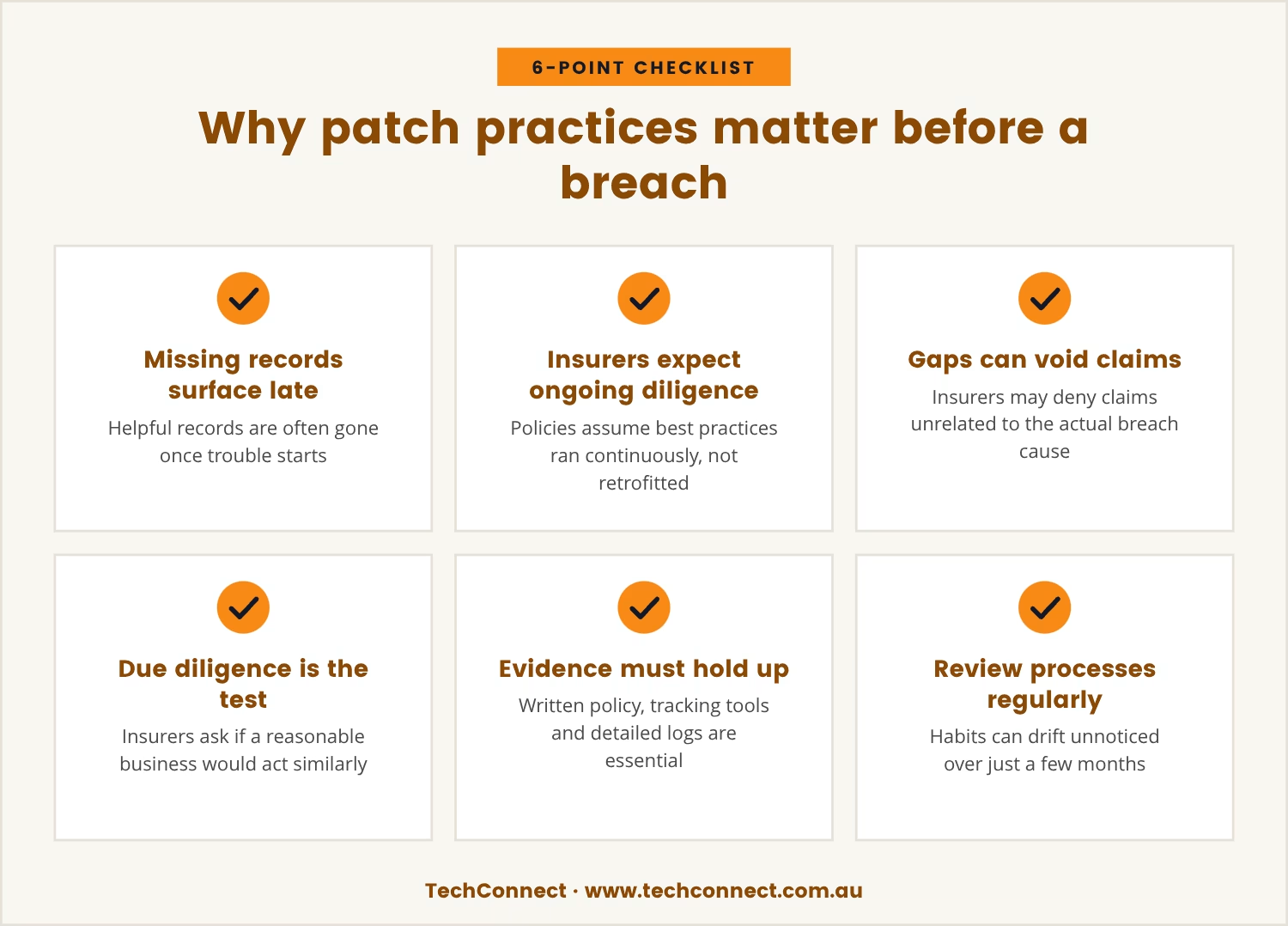
Plenty of businesses only start worrying about patch management after something's already gone wrong — and by then the records that would have helped are the ones that are missing. Insurance terms generally assume best practices were running all along, not stitched together after the fact.
If you can't show consistent, complete patching, an insurer can say you didn't hold up your end, even in cases where the breach had nothing to do with a missed update. What's being tested is due diligence — whether a reasonable business in your position would have done the same.
In practice that means a written policy, decent patch management tools doing the tracking, and logs detailed enough to survive scrutiny. It also means checking the process regularly, because habits that looked fine six months ago tend to drift.
Brisbane businesses carry the same patching exposure as anyone else, and on top of that, local rules and industry expectations add their own layer. Insurers assessing a Brisbane claim will often weigh it against Australian standards or whatever's standard for your particular sector.
Some industries are expected to patch within a set window or use approved tools, and missing that step can be enough on its own to void cover — regardless of whether the regulation directly touches on patch management or not.
Even outside a regulated industry, insurers operating in Brisbane will still expect reasonable patch management strategies and some evidence that staff were trained and the process got reviewed. Local context shapes what counts as "reasonable," so it's worth reading your policy and your industry guidelines rather than assuming either.
A process on paper isn't the same as a process insurers believe. Here's roughly what gets checked.
A written policy spells out who owns patching, how it's tracked, and what happens when something slips. Without it, there's nothing for an insurer to measure you against.
Logs showing when a patch landed, which systems it touched, and who signed off are what actually prove the process ran. Gaps here read as gaps in the process itself.
Automation cuts down the human error that creates missing records in the first place. It also tends to produce exactly the paper trail an insurer wants to see.
Insurers look for evidence that patches get tested before they go live and that the overall process gets checked for holes. A policy nobody revisits stops meaning much.
Training records show your team actually understands the patch lifecycle, not just that a policy exists somewhere. That understanding is what keeps new vulnerabilities from slipping through.
Insurers don't expect perfection — they expect a response. Documenting why a patch was missed and how quickly it got fixed matters more than pretending it never happened.
A decent process can still leak, and insurers know exactly where to look for the leaks.
A strategy that holds up under scrutiny takes more than installing updates on schedule. It needs to survive someone else reading it after the fact.
We tend to think about this in two stages, and we'll say upfront it's an instinct built from doing this repeatedly rather than a formula.
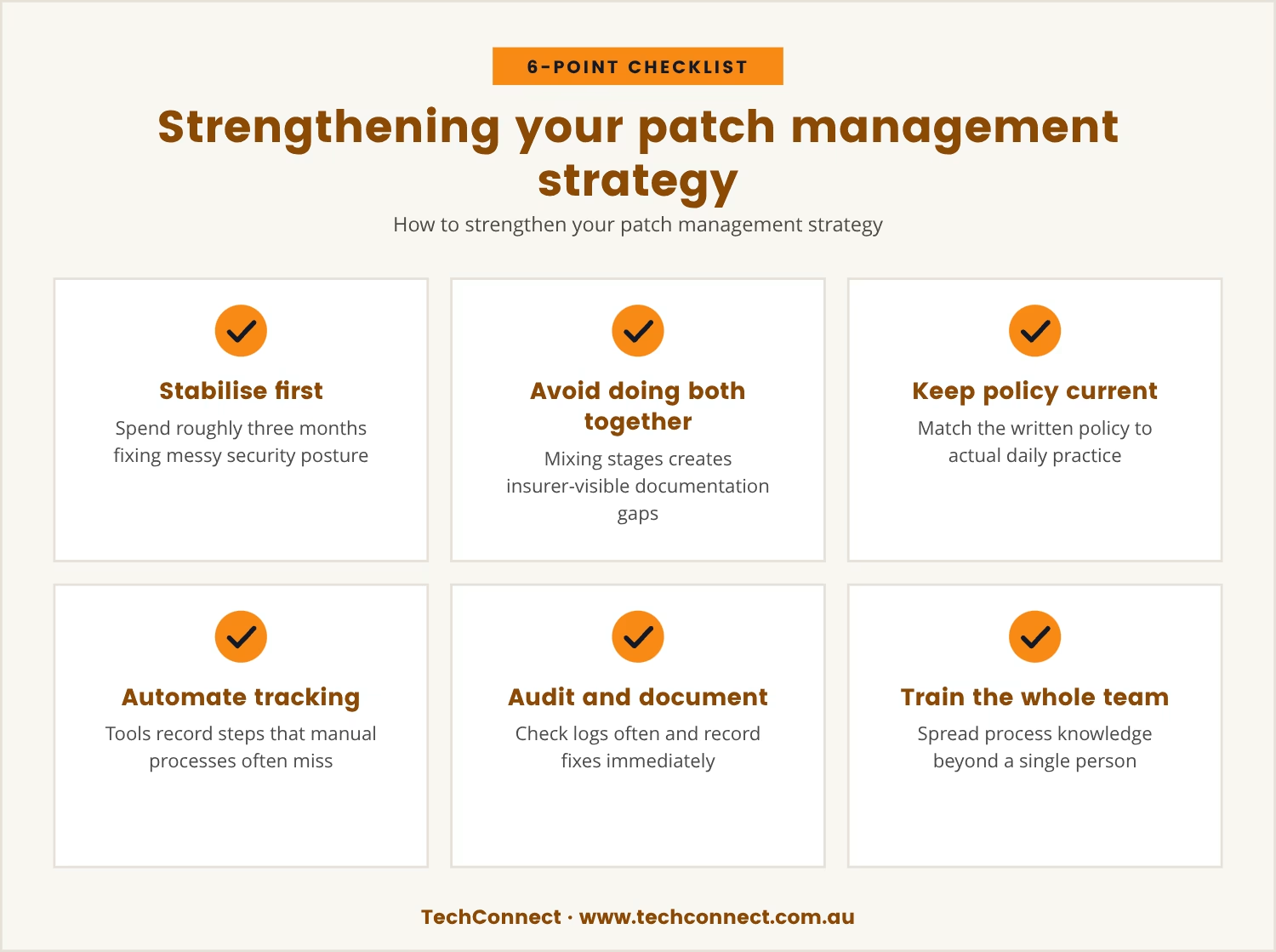
Plenty of environments arrive somewhere between messy and genuinely chaotic — not through anyone's fault so much as years of patching getting deprioritised against everything else running a business. The first stretch, somewhere around three months, give or take, is spent calming that down and getting the security posture to a place that would actually survive an insurer's review.
Only once that's solid do we sit down with the business and reorder priorities toward the improvement and automation projects that make the whole thing easier to sustain long-term. Trying to do both at once, in our experience, is how good intentions turn into exactly the documentation gaps insurers go looking for.
Alongside that: review the policy itself so it matches what actually happens day to day, not what it said two years ago. Lean on automated tools where you can, because they track the steps you'd otherwise forget to write down.
Audit the logs regularly, fix what's broken the moment you find it, and write down what you did about it. Train the team so the process doesn't live in one person's head, especially when staff or systems change. And read your policy's fine print on patching — if you're unsure what counts as enough evidence, ask the insurer directly rather than guessing.
The real risk in inconsistent patch management was never just the breach — it's losing the safety net you thought was underneath you. When a claim gets denied, the recovery costs, the legal exposure, and the lost business all land on you directly.
That's the part that makes patch management more than a technical checklist. It's a business process protecting the company's future, and the records you keep now are what decide whether support shows up when you actually need it.
If it's been a while since anyone looked at your patching process, that's worth fixing sooner rather than later. Would your records stand up to an insurer's review after a breach?

Many businesses with 15 to 70 users trust their patching process but haven’t checked if their records would satisfy an insurer after a breach. At TechConnect, we know how easily small gaps can leave you exposed.
We invite you to see how we approach patch management and what a real conversation about your setup could reveal.
If you find a lower price for the same level of service elsewhere, we’ll match it—no negotiation required.
[.mspl-button-text]Request a price match[.mspl-button-text]
Write a clear policy naming who's responsible, how updates get tracked, and what happens when a patch is missed, then check it still matches what actually happens day to day. Automated tools help keep that record honest, and revisiting the policy as systems change keeps it from going stale.
Look for something that automates deployment, tracks every update, and produces detailed logs across all your operating systems. Reporting, alerting, and integration with your existing security setup are the features that turn routine patching into evidence you can hand an insurer.
The lifecycle runs from spotting a new patch through testing, deploying, and verifying it, and following it in order is what keeps the process consistent. That consistency is exactly what an insurer is checking for when a claim lands on their desk.
It can, in a very small environment, but keeping reliable records by hand gets harder the moment the business grows even slightly. Automated patch management tends to win here simply because it leaves fewer gaps and better evidence that patches went on time.
Document why it happened and get it applied as soon as you reasonably can, and tell your insurer if your policy requires that. A clear record of what went wrong and how you responded is often what protects a claim later, more than the missed patch itself ever would.
We help businesses across Brisbane and SE Queensland achieve their goals sooner with smarter, more reliable technology.